

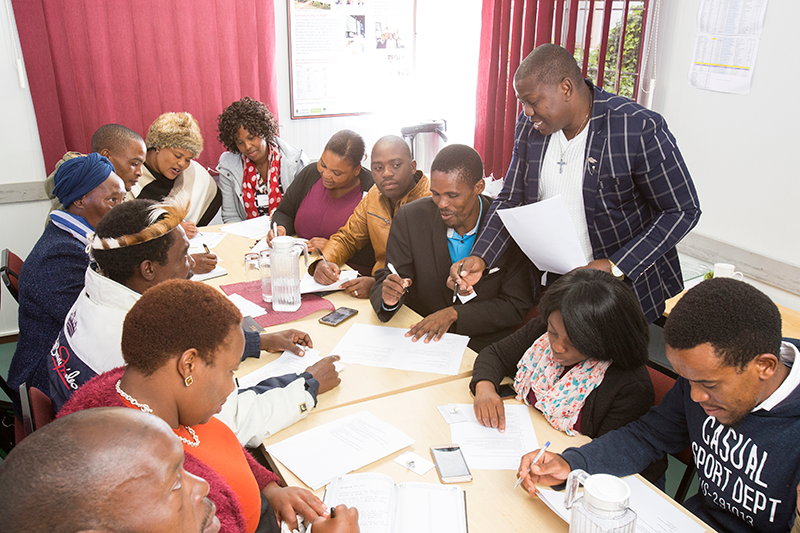
Community engagement is the lifeblood of the clinical research undertaken by the Centre for the AIDS Programme of Research in South Africa (CAPRISA).
Studies undertaken by CAPRISA directly involve entire communities and individuals within the community – making their active involvement essential.
None of CAPRISA’s research would be possible without a strong and well-established partnership between communities and researchers.
Given that community engagement is a core activity, CAPRISA has had a dedicated Community Engagement Core to support its research since its inception in 2002. Community engagement is premised on the five principles of mutual respect, shared ownership of the research and its findings, sensitivity to local norms and cultural practices, appreciation of one another’s needs, aspirations and obligations, and democratic and transparent mechanisms and structures for community members and researchers to engage and work with one another. These principles guide the relationship between researchers and communities.
CAPRISA’s involvement with communities extends far beyond research. For example, in the rural communities where the organisation is conducting research, assistance is provided to local schools to improve their infrastructure. Within the realm of research, extensive community and outreach programmes inform people within communities about HIV and TB; enabling community members to make informed decisions about their own health and HIV risk profiles and whether they are willing to participate in research. These activities avoid being welfare-like handouts and are designed in close consultation with community representatives, including the terminology to be used and the materials developed.
Many of the communities where CAPRISA is conducting research are ravaged by high HIV/AIDS prevalence. Almost every household is impacted, with family members either living with the disease or have their friends and relatives living with the virus. For example, in the Vulindlela community, annual cross-sectional surveys of antenatal clinic attendees demonstrate a concerning rise in HIV infection among young women below the age of 20; increasing from 13.0% in 2007 to 22.1% in 2013. The 2013 survey revealed that HIV prevalence was 39.7% among pregnant women aged 20-24 and 63.1% among those aged 25-29. More recent epidemiological surveys in uMgungundlovu, which is one of the worst affected districts in KwaZulu-Natal, show that HIV prevalence is at 36.3%; reaching a high of 70.2% among women aged 31-32.
High rates of HIV, especially among young women, is the priority health concern in these communities and CAPRISA’s research agenda seeks to address this challenge by monitoring the epidemic, understanding its risk factors and developing and testing new HIV prevention technologies for women. In Vulindlela, a large community-based survey revealed a “cycle of HIV transmission” driven by high rates of HIV acquisition among adolescent girls and young women (15-25 years), principally from men close to or in their 30s (an average of eight years older). These men are likely to have acquired HIV from women aged 25-40 who have the highest HIV prevalence. When the current group of adolescent girls and young women reach their 30s, they will constitute the next group of women with high a HIV prevalence, thereby perpetuating the cycle of transmission to men in their 30s who will infect the next cohort of adolescent girls and young women. These findings highlight the importance of age-disparate relationships in driving HIV transmission in South Africa. The research results have shaped both the global and local HIV response and were adopted by UNAIDS, forming the basis of the 2016 UNAIDS Report on the Life Cycle approach to HIV. This report has been used by several African countries to inform national policies and planning. For example, the first objective of the South African National AIDS Plan is to break the “Cycle of HIV transmission” through reducing HIV incidence in young women.
Building on its initial discovery of preventing sexually transmitted HIV with antiretroviral pre-exposure prophylaxis, CAPRISA is testing two new HIV prevention approaches. The first is six-monthly potent and broadly neutralising antibodies as a passive immunisation and the other is an annual antiretroviral-based implant, a matchstick-sized rod inserted under the skin.
The prevention studies undertaken by CAPRISA involve extensive community consultation prior to commencement through community structures known as community research support groups which include a wide range of stakeholders. These groups provide structured input and enable community voices to be heard. Community representatives provide direct input in the study design, the consenting process and the way in which results are disseminated to the community.
The process of community engagement is designed to leave communities better off. More importantly, it is designed to empower communities through their influence and involvement in research. This is a challenging process that has to deal with complex community dynamics, including those that jockey for positions while others do their best to improve conditions. A fair and transparent process is central to achieving community engagement that is mutually beneficial to both researchers and the community
Words: Taschica Pillay
Photo: Supplied