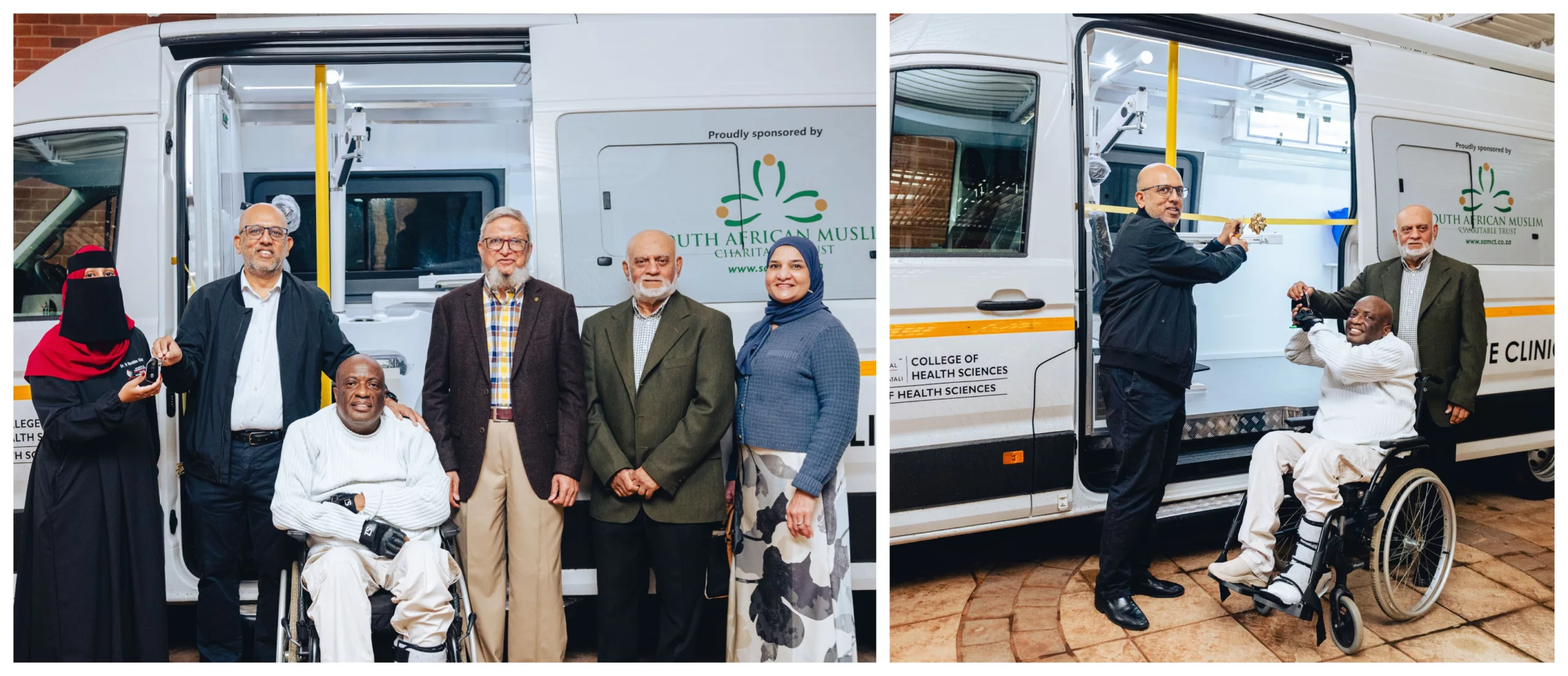
A state-of-the-art Mobile Eye Clinic, valued at more than R2.1 million, was donated to the University of KwaZulu-Natal’s (UKZN) Foundation to support the Discipline of Optometry in delivering vital eye-care services to rural and under-served communities across KwaZulu-Natal, where access to healthcare remains a challenge.
The fully equipped vehicle, provided by the South African Muslim Charitable Trust (SAMCT), will enable the Optometry Discipline to conduct on-site eye screenings, comprehensive eye examinations and provide corrective eyewear. The clinic will help reduce preventable vision impairment and improve the quality of life for vulnerable populations.
The mobile clinic includes eye test instruments for both adult and paediatric patients. Examples include: an autorefractor, which automatically estimates the power of corrective lenses required; a handheld slit lamp to view the anterior structures of the eye; and a handheld ocular fundus camera to capture images of the posterior structures, assisting in the detection of pathologies. Additional equipment allows practitioners to test contrast sensitivity, depth perception, and intraocular pressure.
Mr Gaff Osman, chairman and trustee of SAMCT, said: “By supporting this initiative, we aim to help bridge the gap in access to quality eye-care services in rural communities across the province. At the same time, this project will offer invaluable hands-on training for UKZN’s Optometry students, allowing them to integrate academic learning with practical service, while making a real difference in disadvantaged areas.”
Dr Naimah Ebrahim Khan, Head of the Discipline of Optometry, expressed her delight when she received the keys to the mobile clinic. “During World Sight Month, it is so important to raise awareness of the high rate of preventable blindness which is a barrier to a huge portion of our population from living a good quality of life,” she said. “We are deeply thankful for this generous donation. The Mobile Eye Clinic represents more than just equipment – it is a lifeline for communities with little or no access to eye-care and an invaluable training ground for our students ensuring that they graduate as competent, compassionate practitioners ready to serve society.”
Mr Shabir Chohan, Chief Executive Officer of Al Baraka Bank and trustee of SAMCT said: “We are delighted to play a role in something that is so beneficial to the community. As an alumnus of UKZN, having trained some 40 years ago, all education projects such as this wonderful initiative are very important. Alumni of UKZN have a meaningful role to play in advancing education. Congratulations to Naimah for initiating this project.”
Mr Gaff Osman, Trustee of SAMCT and Board member of the UKZN Foundation, added: ‘Since its formation in 2008, SAMCT has supported major projects throughout South Africa, aimed at improving healthcare access and advancing education. As a proud UKZN alumnus, I believe this mobile eye clinic will bring long-term benefits for both healthcare delivery and student training.”
Professor Khathutshelo Percy Mashige, Dean of the School of Health Sciences and an optometrist by profession thanked SAMCT for the generous sponsorship. He said: “In the College of Health Sciences (CHS), we target students from vulnerable communities in KZN, especially those from Quintile 1-3 schools. This mobile clinic will go a long way in supporting disadvantaged communities. We believe this marks the beginning of a long-lasting partnership between UKZN and SAMCT, built on shared objectives.”
Also present at the handover was UKZN alumnus (Class of 1971) and SAMCT education consultant, Mr Farouk Bayat. A recipient of the OR Tambo Principal’s Lifetime Achievement Award, Bayat is well known for his philanthropic work. He previously donated his R160 000 prize to fund an Information and Communications Technology (ICT) centre at a disadvantaged school in Cibini, Ixopo. “Our students are the future healthcare professionals in our province,” he said. “It is encouraging that CHS recruits students from deep rural areas. Our role is to train them so that they can return to their communities and perform life-changing procedures such as cataract removal. I wish you much success with the new mobile clinic.”