With a powerful vision to support school learners, the University of KwaZulu-Natal (UKZN) has partnered with four secondary schools in KwaZulu-Natal to launch the UKZN STEM Learner Enhancement (STEM LE) School Outreach Project, aimed at advancing Science, Technology, Engineering, and Mathematics (STEM) teaching, while also providing holistic school development.
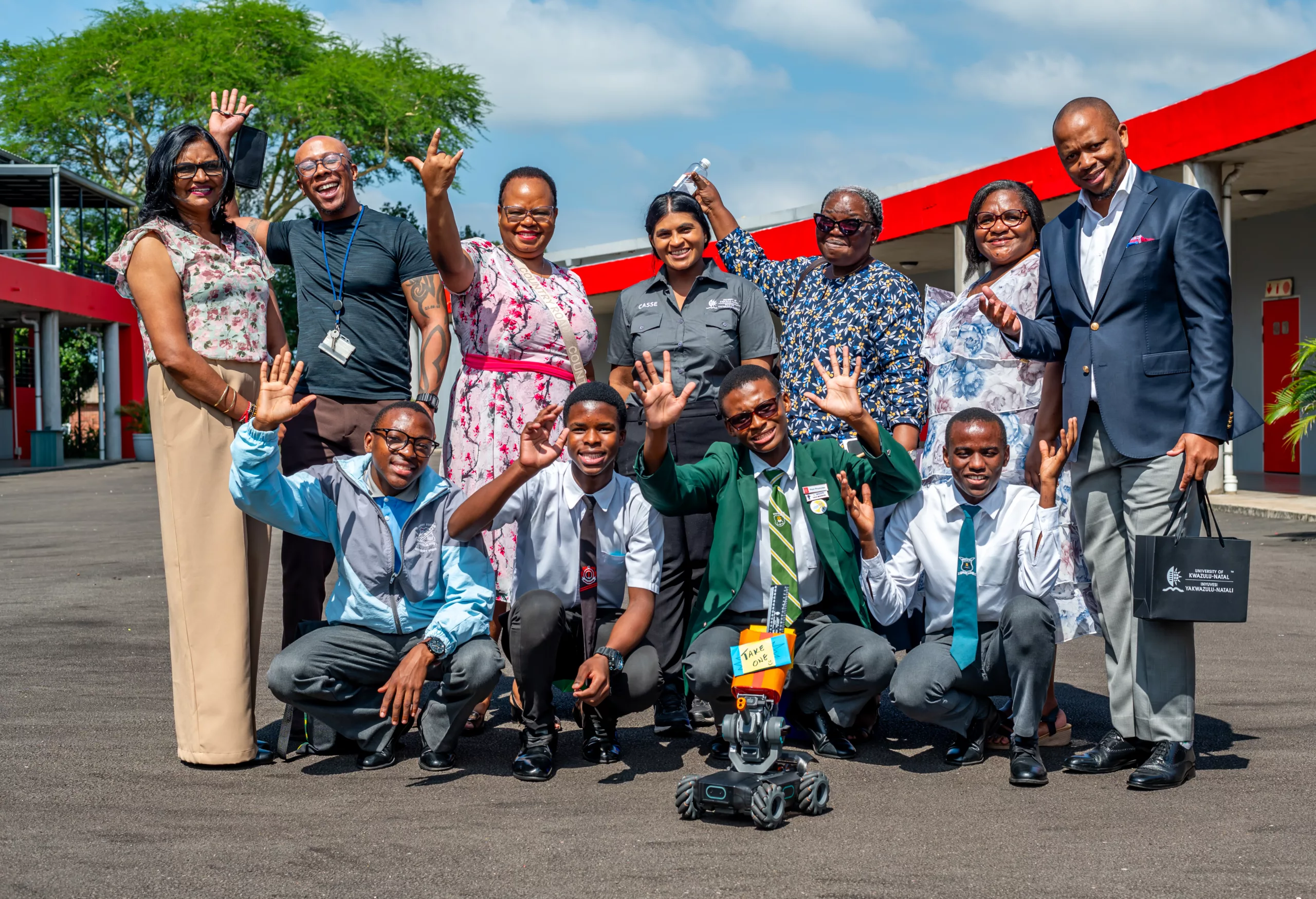
UKZN hosted an event to launch the pilot phase of the Programme with the four schools – Kwasanti Secondary School, Margot Fonteyn Secondary School, Sithokozile Secondary School, and Nilgiri Secondary School. This pilot marks the first step in an ambitious, university-wide initiative that will draw together expertise from across disciplines to support the selected schools through collaborative, impactful, and community-responsive interventions. These include UKZN academics and postgraduate students hosting interactive sessions with Grade 11 learners. The sessions will focus on problem-solving and critical thinking as well as providing career guidance.
The initiative will be multidisciplinary in nature, combining academic, professional, and wellness expertise to foster comprehensive development in partner schools. It aims to develop and implement innovative STEM teaching and learning approaches that promote both academic excellence and personal growth.
Addressing an audience of officials from the Department of Basic Education, University executives, as well as principals, educators and learners from the four selected schools, UKZN Interim Director: Teaching and Learning, Professor Nyna Amin introduced the project, saying: “This initiative was inspired by Professor Thabo Msibi (UKZN Deputy Vice-Chancellor: Teaching and Learning) whose heart and soul has always been deeply entrenched in Education, particularly with students.”
Amin highlighted growing concerns of declining learner performance in STEM subjects.
“South Africa’s 2024 National Senior Certificate results were encouraging because 87.3%, of learners passed matric – the highest pass rate recorded in the country. However, only 40.9% obtained enough points for university admission, and in mathematics the pass rate was only 47.8%.”
“Mathematics, technology and engineering are not just examination subjects – these are the pathways to a better future.”
Amin explained that the pilot project is about more than just enhancing knowledge. “The University does not only exist to receive talented graduates, its deeper obligation is to help create the conditions in which talent can emerge and flourish. The pilot recognises that learning and well-being are inseparable and so it will incorporate wellness support alongside subject-specific interventions.”
Mr Thulasizwe Kojane, Regional Skills Advisor at the Chemical Industries Education and Training Sector Authority (CHIETA) made a firm commitment to funding the project and appealed to learners to embrace the opportunity.
“The reason why CHIETA partnered with UKZN is to collaborate. Our vision is to help people realise their full potential and we see UKZN as a driver in us achieving that objective. To the learners – let’s work hard and focus on the things that are important and the future will be bright,” said Kojane.
Ms Nonhlanhla Mthembu, KZN Department of Basic Education Co-ordinator for Mathematics, expressed her full support for the programme.
“This initiative comes at a critical time when the need to enhance learner participation and performance in mathematics has never been greater. This is a powerful partnership between the schools, the University and broader education system. Together, we can bridge the gap between potential and performance.”
Beyond strengthening teaching and learning, the project aims to enhance the visibility of UKZN as a leading institution in STEM education. The launch of the pilot phase represents a meaningful step toward reimagining the relationship between UKZN and the communities it serves.
As part of the programme, learners received a fun and informative science demonstration by UKZN Science Technology Education Centre (STEC). The event closed with the presentation of a data projector and science kit to each school.