UKZN’s Aerospace Systems Research Group (ASReG) catapulted its researchers into schools and science centres to promote studies and careers in science, technology, engineering and mathematics (STEM), specifically in the aerospace industry, and to support the world’s largest annual space event, World Space Week.
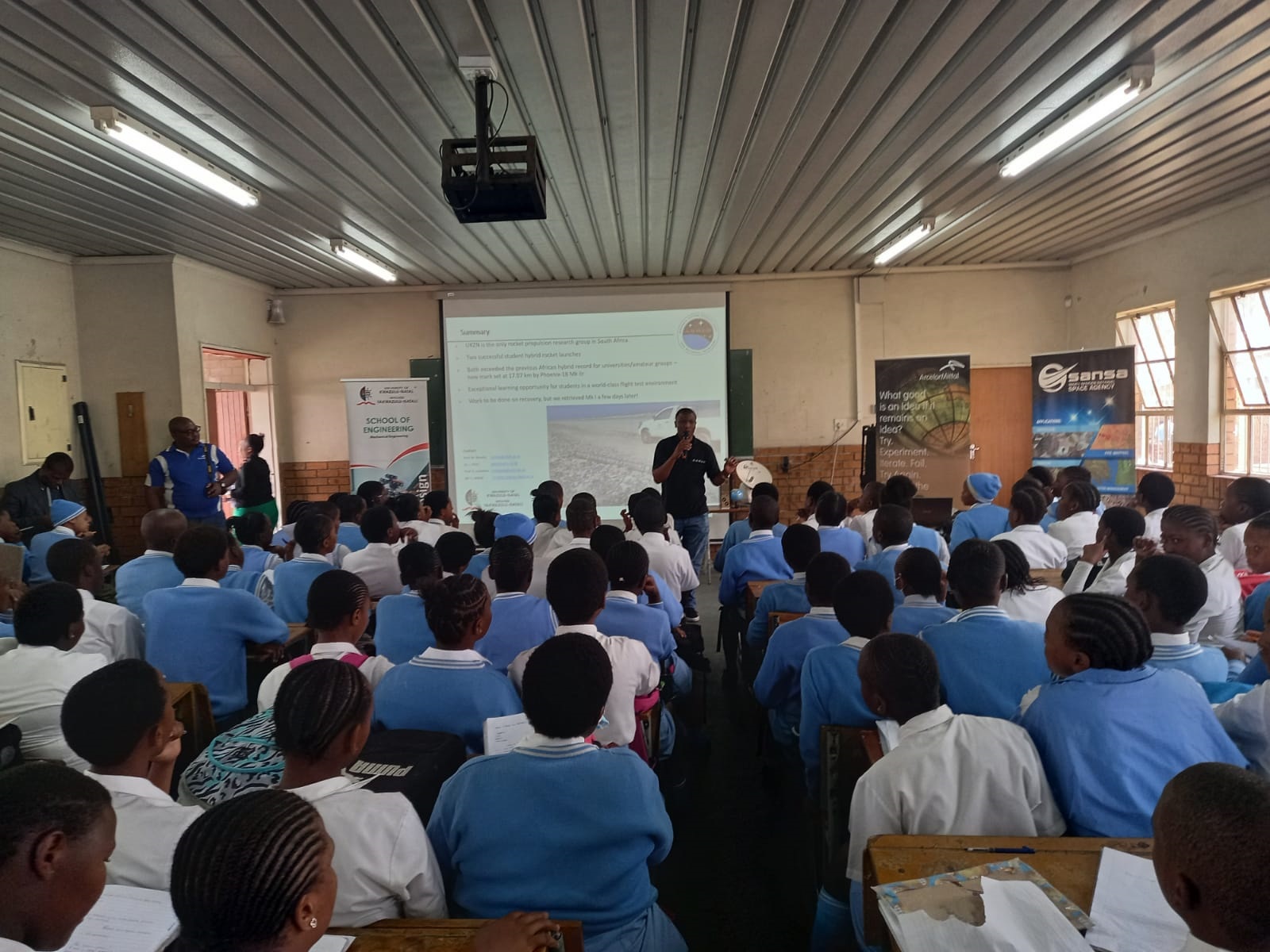
The first series of visits to 1 124 Grade 9 learners at 10 schools in Madadeni and Osizweni in the Amajuba District in northern KwaZulu-Natal (KZN) was facilitated by the ArcelorMittal Science Centre in Newcastle in partnership with the KZN Department of Education, the South African National Space Agency (SANSA) and ASReG, funded by the Department of Science and Innovation (DSI).
Postgraduate students, Mr Vulinhlanhla Mchunu and Mr Mthobisi Tshomela encouraged learners to choose science-related subjects and careers in space science and made them aware of the academic and professional opportunities in this sector. SANSA focused on the use and importance of satellites with respect to telecommunication, disaster management, urban and regional planning, and weather services.
In their interactive presentations, Mchunu and Tshomela covered various topics, including an introduction to space technology, the working principle of rockets and satellites, ASReG and its role in aerospace propulsion engineering, the Phoenix Hybrid Rocket Programme, and how to gain entrance to engineering at UKZN and excel at university. Presenting primarily in isiZulu to students at township schools, this marked a milestone for ASReG as they described rocket engineering activities at UKZN in the learners’ home language.
Mchunu and Tshomela are conducting their studies in the discipline of Mechanical Engineering within ASReG, a research group established by Professor Mike Brooks and Dr Jean Pitot to conduct applied research in rocket propulsion and associated technologies with the aim of developing aerospace technologies related to rockets and space vehicles and developing human skills in aerospace engineering. Practically, ASReG focuses on the design, manufacture, and testing of rocket propulsion systems.
ASReG is committed to uplifting the basic education system in South Africa and building awareness of the importance of space technology in the lives of citizens – encouraging young South Africans to pursue careers in STEM fields. Funded through ASReG’s grant from the DSI, this tour supported a key responsibility to promote space-related activities through STEM outreach initiatives.
The week’s successful activities included educational giveaways and prizes such as UKZN-branded backpacks, pencil cases, and pamphlets promoting UKZN’s College of Agriculture, Engineering and Science.
ASReG joined I-Innovate for a hands-on programme at the Christoph Meyer Maths and Science Centre (CMMSC) in KwaNhlamvu in northern KZN, made possible by the support of Tata Consultancy Services and the DSI, where ASReG and I-Innovate inspired future STEM leaders, innovators, and educators.
They reached almost 500 students and 40 teachers by working directly with them through practical problem-solving activities, space-related experiments, and learning materials to inspire them to pursue careers in the aerospace industry, and educated the public about STEM fields while fostering international co-operation in space outreach and education.
The programme included interactive talks and an introduction to the plethora of skills applied to rocket and satellite science.
ASReG covered basic rocket physics and an introduction to hybrid fluid mechanics. The researchers spoke about the Phoenix Hybrid Rocket Campaign trials and successes and the Ablative Blow-down Liquid Engine (ABLE) Liquid Rocket engine test campaign, the first successfully developed liquid rocket engine in South Africa and the second most powerful university-developed liquid rocket engine in the world. They described ASReG’s future projects that include engines and launch vehicles to take Africa to space.
ASReG’s engineers also covered their own research and roles and the challenges they faced in developing these devices to give insight into the perseverance needed for a career in science.
When viewing footage of ASReG’s rocket engines being tested, rockets flying and one even failing, learners described their inspiration and budding interest in becoming planetary scientists.
Learners were able to design, build and test their own rockets using plastic bottles, cardboard fins and a propellant, a highlight in the programme. They witnessed two complex water rockets being launched to heights of 60m as ASReG and I-Innovate described the steps of the engineering design process and demonstrated the basics of rocket flight.
Activities were inspired by partners and the Jet Propulsion Laboratory at the California Institute of Technology, the Berkeley Lab, the US Department of Energy Joint Genome Institute, and the United Nations. Students and teachers won prizes and each classroom received a planetary and a “Moon’s Earth” poster aligned with their classroom curriculum.
This programme benefited scholars by inspiring them about future career opportunities, enhancing their school curriculum through input from professionals, introducing practical applications of the curriculum, and connecting learners to possible careers and tertiary pathways.