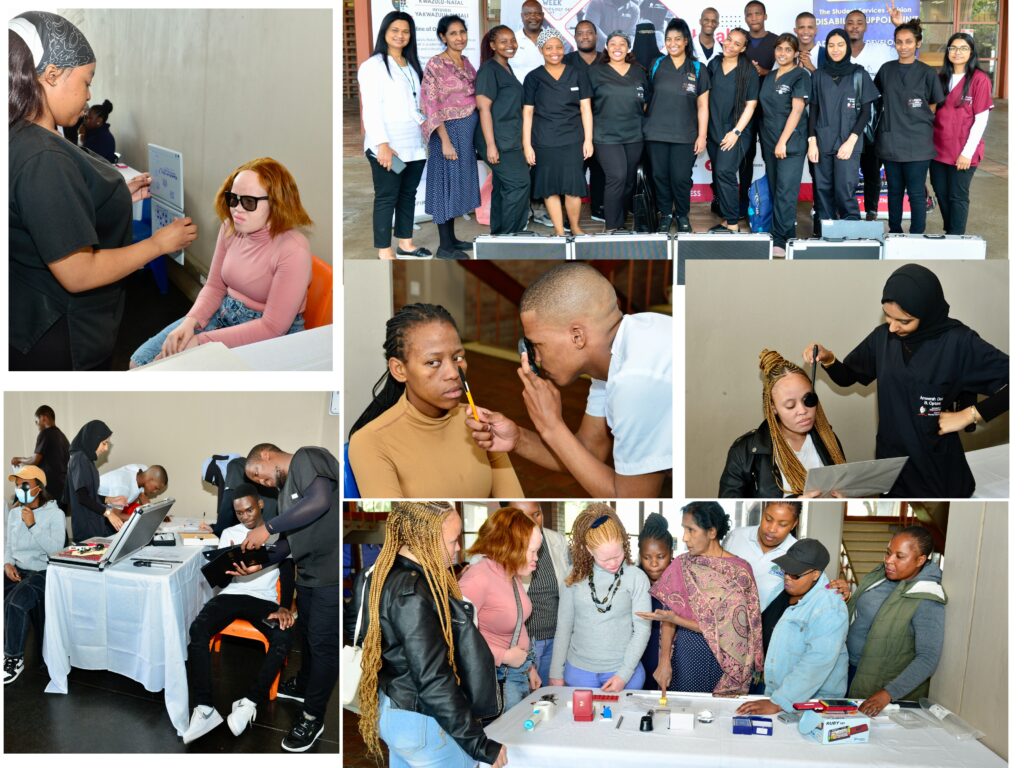
In commemoration of World Sight Day on 12 October, UKZN’s Disability Support Unit (DSU) in partnership with the College of Health Science’s School of Optometry hosted free eye screening for students and staff on the Westville campus.
World Sight Day aims to raise global awareness of eye care treatment, vision impairment and prevention of blindness.
The School of Optometry and the DSU recognise the importance of making eye care accessible to all, including people living with disabilities. The joint initiative focused on “eye health in the workplace”.
Third-year Optometry students conducted the screening for visual functions such as distance and near visual acuity, colour vision, binocular vision and ocular health assessment. Those found to have visual challenges or eye pathologies were referred for a comprehensive examination at an eye clinic.
UKZN’s Optometry Department offers free eye testing to students, staff and their family members and the community from Monday to Friday with each day dedicated to a particular specialty as follows:
Monday – Low vision
Tuesday – Paediatric vision
Wednesday – Binocular vision and general refraction
Thursday – Contact lenses
Friday – General refraction
Senior lecturer in Optometry Dr Urvashni Nirghin said, ‘It’s important that the UKZN community is aware of these assessments and that they spread the news to their communities. Our focus is on preventative measures, early diagnosis, interventions and management.’
A DSU Independence Trainer noted that not everyone can afford to pay for optometry. ‘This initiative is our small contribution to reach out to our students and staff with the help of Optometry.’
The DSU also mounted a display of equipment that can be used by blind or partially sighted individuals to foster independence such as the white cane with obstruction sensors and a measurement tool that identifies bank notes by length.
Words: Zama Khoza
Photographs: Albert Hirasen