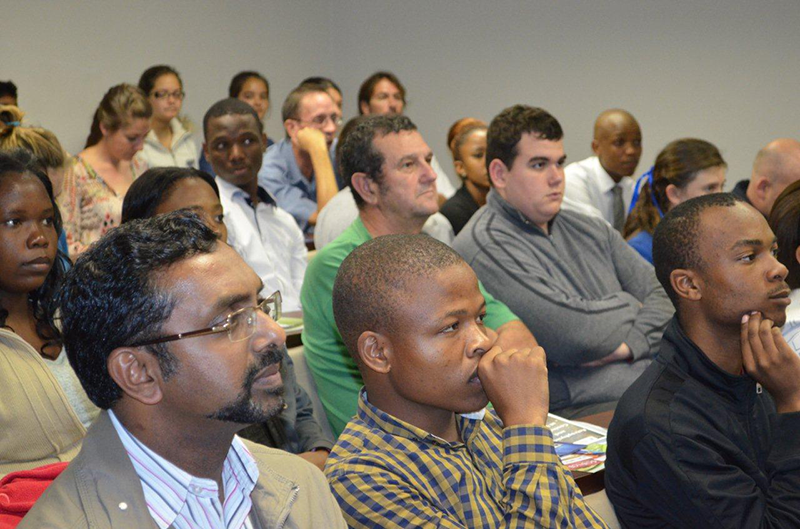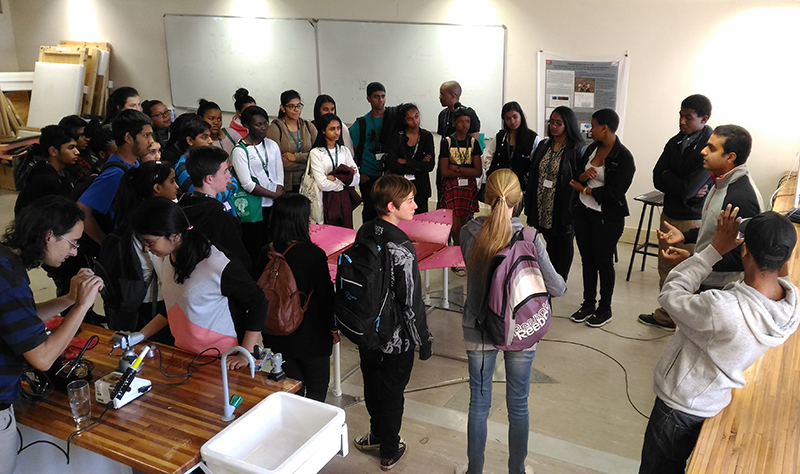
For the past eight years, UKZN’s Astrophysics and Cosmology Research Unit (ACRU) has been reaching out to learners from disadvantaged communities in a bid to encourage them to explore the field of science astronomy.
ACRU’s Senior Project Officer, Mr Strini Rajgopaul, described Astronomy as an exciting multi-faceted subject which combines science, technology and culture.
“It drives job creation, economic activity, technological development, scientific discovery, international partnerships and education. It is currently a scarce skill in South Africa. The country needs to increase human capacity in astronomy so that sufficient personnel are available to work at its world-class telescopes such as UKZN’s Hydrogen Intensity and Real-time Analysis experiment (HIRAX),” said Rajgopaul, adding that a sufficient number of astronomers are needed to solve unanswered questions that drive research.
Increasing the number of astronomers will, so said Rajgopaul, also lead to an enhancement of the local workforce because astronomy training gives students cutting-edge transferable skills- from engineering to data analysis- that are crucial to the knowledge and financial economy of the 21st century.
The Unit’s outreach activities- currently funded by the SKA (Square Kilometre Array) South Africa’s Africa Science Promotions Office- have been successful in recruiting both undergraduate and postgraduate students to study at UKZN. The SKA project is an international effort to build the world’s largest radio telescope, with a square kilometre (one million square metres) of collecting area.
The scale of the SKA represents a huge leap forward in both engineering and research and development towards building and delivering a radio telescope and will deliver a correspondingly transformational increase in science capability when operational. Deploying thousands of radio telescopes, in three unique configurations, it will enable astronomers to monitor the sky in unprecedented detail and survey the entire sky thousands of times faster than any system currently in existence.
The SKA telescope will be co-located in Africa and in Australia and will have an unprecedented scope in observations, exceeding the image resolution quality of the Hubble Space Telescope by a factor of 50 times, whilst also having the ability to image huge areas of sky in parallel. With a range of other large telescopes in the optical and infrared being built and launched into space over the coming decades, the SKA will perfectly augment, complement and lead the way in scientific discovery.
“Outreach also educates the local community on developments in astronomy. It attracts disadvantaged and female students to study Astronomy, Mathematics and Physical Science (which are scarce skills in South Africa) at an undergraduate and postgraduate level; emphasises how astronomy benefits society and increases awareness of other lesser-known dimensions of astronomy, for example, the link between astronomy and creativity,” said Rajgopaul.
The outreach programme was benchmarked on national and international astronomy outreach programmes and includes presentations at schools, astronomy open days, career fairs, public talks, disseminating information using conventional and social media and arranging work experience programmes. Beneficiaries include high school learners, teachers, amateur astronomers as well as members of the public.
“High school learners receive career guidance, learn about the various jobs that are available to professional astronomers (apart from astronomy), obtain information on available bursaries, acquire work experience and gain a richer understanding of their science curriculum. Apart from educating, outreach conveys the excitement of astronomy to these learners since astronomy information that fascinates and inspires is presented in a format that is easy to comprehend. Teachers who attend the astronomy open days and the astronomy presentations that are delivered at schools benefit by enriching their knowledge of science. Amateur astronomers receive information which fuels their passion while members of the public are educated on exciting developments in astronomy,” said Rajgopaul.
He said interactions with high school learners revealed that most were unaware of career opportunities available to astronomers, also adding that they (learners) do not have a keen grasp of the socio-economic benefits that astronomy offers. However, it is difficult to recruit a large number of previously disadvantaged postgraduate students as most graduates seek employment after their undergraduate studies. “Another obstacle to recruiting previously disadvantaged postgraduate students is that most high performing students at high school are not aware of the career options available to a professional astronomer. As a result, these students opt to study careers that are more popular such as engineering and medicine,” he said.